DPI Responsible Investment Policy (July 2026)
1. Background
Development Partners International LLP (“DPI LLP”, “DPI” or the “Firm”) is a regulated financial institution, acting as an investment adviser, providing investment advice on private market transactions, principally pan-African private equity investments (“Portfolio Company “, Portfolio Companies”, “Investment” or “Investments”) through diversified collective investment schemes (the “ADP Funds” or “Funds”).
DPI believes that effective management of environmental, social and governance (“ESG”) issues, as well as activities related to the achievement of the United Nation Sustainable Development Goals, is essential to the long-term success of these Portfolio Companies and the development of the markets in which they operate. Therefore, responsible investment (‘RI’) means investing in sustainable businesses, whilst also delivering competitive returns and generating positive environmental and social outcomes supported by strong governance. As a responsible investment advisor, DPI, through the Investments by the Funds it advises, is also committed to its core stewardship objective of active engagement and aims to use its influence over the Portfolio Companies to maximise long-term value.
2. Approach
The key tenets of RI, which have been a part of the DPI DNA since its inception, were formalised by the DPI partners through approval of the updated versions of DPI Impact Management system (DPImpact) and the DPI ESG Management System (DPIms) in December 2025. As such this policy has been updated, from those foundations, to ensure the responsible management of iESG matters at each of DPI’s Portfolio Companies. This policy seeks to set out DPI’s commitment to the integration and management of material iESG risks and opportunities across the Firm’s investment process, from origination to exit, as well as DPI’s approach to iESG value creation and stewardship.
DPI has a mission to drive positive, long-lasting social, environmental and economic impact across Africa. This is reflected in the Fund’s intentionality to contribute towards the UN Sustainable Development Goals (“SDGs”) and create impact within the Portfolio Companies across gender equality, job growth and job quality, and climate change. DPI also seeks to identify additional impact themes specific to each Portfolio Company, such as financial inclusion, access to health products or food, and support in scaling the businesses to increase the reach of the company’s products and services.
Impact considerations, alongside ESG issues (together “iESG”), are firmly integrated into the DPI investment process. This allows the Firm to measure and monitor the iESG performance of Portfolio Companies against the Funds impact objectives, as well as their contribution towards the SDGs.
The PRI (one of the pillars in DPIs reference framework – see below) defines stewardship as “the use of influence by institutional investors to maximise overall long-term value including the value of common economic, social and environmental assets, on which returns and clients’ and beneficiaries’ interests depend”. DPI, through the Investments it proposes to the Funds, seeks to exert its influence by collaborating, as a shareholder, with the board of directors of each of the Portfolio Companies – through both active engagement and voting (for example, through voting rights and board resolutions). DPI also extends its stewardship to supporting Portfolio Companies’ management teams with implementing changes necessary to align with international best practices through the provision of example, template and advice, providing access to financing or expert network and reviewing outputs.
DPI is a member of the Global Impact Investing Network, the Initiative Climat International, a signatory of the Operating Principles for Impact Management and a qualified investment of the 2X Global Challenge, drawing on guidance from industry bodies, as set out below, in applying its impact framework
3. Scope
This policy applies to each of the Funds, with adoption across the Firm by all DPI staff members and partners.
DPI’s RI Policy is guided by its duty to iESG matters and the approach has been developed from internationally recognised iESG principles and standards. These pillars form part of DPI’s Reference Framework surrounding iESG, and include but are not limited to:
- The International Finance Corporation (IFC) Performance Standards on Environmental and Social Sustainability (January 2012)
- The World Bank Group Environmental Health and Safety Guidelines (April 2007)
- UN Guiding Principles on Business and Human Rights (June 2011)
- ILO Declaration on Fundamental Principles and Rights at Work (June 2010)
- UN Principles for Responsible Investment (UNPRI)
- The UN Sustainable Development Goals
- The Impact Principles (OPIM)
- The 2X Challenge
These standards provide guiding principles in addressing environmental, social, governance, stewardship and human rights factors across investments in each of the Portfolio companies.
DPI has been developing these principles since inception, with each Investment reviewed on its own merits. As such these principles are applied on a case-by-case basis, where DPI believes it can add the most value at the time of investment, but often cannot be applied retrospectively. In specific cases, especially with separately managed accounts (“SMA”), DPI will apply the RI policy as deemed appropriate.
4. Implementation
DPI has committed to providing sufficient resources for the effective implementation of responsible investment and the Firm’s ESG and Impact Management Systems (DPImpact and DPIms). This includes providing DPI staff and partners with knowledge, training and tools to enable them to identify and manage iESG matters across the Funds. This includes having dedicated staff responsible and accountable for the day-to-day implementation of the policy as well as the use of external subject matter experts where appropriate. The overall responsibility of implementation of this policy also lies with the senior management of the Firm, with oversight from the CEO.
iESG, RI and stewardship are embedded across the firm’s investment cycle from screening and due diligence, through to monitoring and exit. This is illustrated by the DPIms, as set out below:
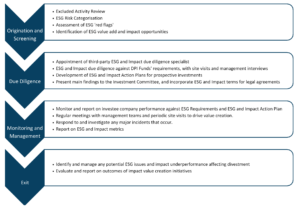
DPIms is reviewed on an annual basis to address industry developments, or any new material ESG matters which may arise from time to time. DPImpact is verified every 2 to 3 years against the framework of the Operating Principles for Impact Management (“OPIM”).
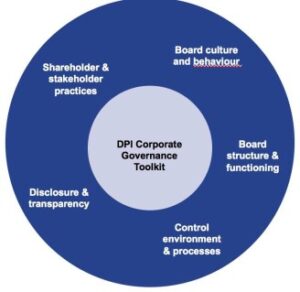
The Firm has also developed a governance toolkit to ensure that boards at the Portfolio Company level are equipped to make decisions, with oversight from DPI, for a sustainable long-term outlook.
5. Responsibility
DPI has a dedicated team (“iESG Team”) that is responsible for the implementation of both the DPIms and DPImpact. The team is headed by the Head of iESG, who reports directly to the CEO. The iESG team has the ultimate responsibility for overall management of iESG issues, including developing, implementing and supervising the DPIms and DPImpact, as well as ensuring all RI and iESG matters are extended to all staff.
The Head of iESG is responsible for the integration of iESG matters across the investment process, as well as the application of the DPIms and DPImpact. The iESG team includes ESG and Impact experts and specialists, whose role it is to identify, assess and manage iESG risks and opportunities, including conducting operational level iESG due diligence, monitoring of each of the Portfolio Companies and reporting of Funds iESG activities.
The Investment Committee of the Firm analyses iESG issues and opportunities as an integral part of the investment decision-making process.
Post-investment, the investment professionals working with the Value Creation team, are responsible for deal assessments and on-going monitoring of Portfolio Companies. This includes formal governance through board positions which ensures the progress against the iESG Action Plans and implementation of the DPI stewardship approach.
6. Engagement
DPI supports the Portfolio Companies in addressing and mitigating ESG risks, whilst still aiming to maximise the impact value creation opportunities, by ensuring compliance with international standards and best practice.
The Firm encourages Portfolio Companies to reduce ESG risks and improve their overall sustainability performance on a continuous basis through:
- The development of iESG Action Plans which are agreed by the relevant DPI investment team with the management of each Portfolio Company and then formalised in legal documentation. Each iESG Action Plan is based on the findings and baseline assessment of iESG metrics collected as part of the initial (pre-investment) due diligence process.
- Periodic monitoring of Portfolio Company compliance in line with DPI’s reference framework where the iESG team provides support in driving actions that align with best practice.
- Regular engagement with Portfolio Company management teams on progress against the iESG Action Plan, through periodic meetings and annual site visits.
- Inclusion of discussions of iESG-related issues at Portfolio Company Board meetings.
7. Transparency and Collaboration
The Firm seeks to invest responsibly by ensuring transparency and communicating its process, goals and progress against clearly defined action plans with all relevant stakeholders, including investors, prospective portfolio companies, and industry organisations.
To support its commitment to the UNPRI and contribute towards improvements within the private equity industry, DPI engages with stakeholders on iESG matters by:
- Engaging employees, Portfolio Companies and other stakeholders regularly to clarify the approach to integrating IESG,
- Participation as part of its stewardship activities in external collaboration with relevant industry bodies such as the UNPRI, the GIIN, OPIM, AVCA, ILPA and iCI.
- Management of any potential conflicts of interest between investors and the Funds. Appropriate governance processes have been set up to reflect this commitment.
Further detailed engagement practices on stewardship are set out later in this policy document.
8. Reporting
The Firm reports on its responsible investment approach and activities through its Annual ESG Report to investors, highlighting ESG performance across the Funds and underlying Portfolio Companies. In addition, ESG metrics surrounding employment and health and safety statistics are included within the Firm Portfolio Report which is issued to investors on a quarterly basis.
DPI also publishes an Impact report, on an annual basis, providing further information on its impact management and monitoring process as well as Portfolio Company-level results and have committed to publishing a TCFD aligned report which will transition to an IFRS aligned report when DPI reaches the obligation threshold.
9. Policy Updates
This policy has been approved by the senior management of the Firm, the DPI Partnership and will be reviewed on a regular basis. This is the second iteration of the policy.
10. Guidelines
This Policy addresses key ESG factors and includes the following:
10.1 Exclusions
These exclusions apply to all Investments; Funds will not invest in the following ‘Prohibited Activities:
-
- Production or other activities involving forced labour or child labour;
- Production of or trade in any product or activity deemed illegal under applicable local or national laws or regulations or international conventions and agreements applicable in any relevant location;
- Activities, products or services related to prostitution;
- Trade in wildlife or production or trade in wildlife products regulated under the Convention on International Trade in Endangered Species (CITES) or Wild Fauna and Flora;
- Production or use of or trade in radioactive materials (other than the purchase of medical equipment, or quality control (measurement) equipment and any equipment where IFC considers the radioactive source to be trivial and/or adequately shielded);
- Production or use of or trade in unbounded asbestos fibres (this does not apply to purchase and use of bonded asbestos cement sheeting where the asbestos content is less than 20%);
- Cross-border trade in waste and waste products other than in compliance with the Basel Convention on the Control of Trans-boundary Movements and their Disposals;
- Unsustainable fishing methods such as blast fishing and drift net fishing in a marine environment using nets more than 2.5 km in length;
- Production of, use of or trade in pharmaceuticals, pesticides/herbicides, chemicals or wastes; ozone depleting substances; Polychlorinated biphenyls and other hazardous substances which are the subject of an international convention that provides for the phasing out or banning of their use;
- The (a) elimination or severe diminution of the integrity of a habitat caused by a major, long-term change in land or water use or (b) modification of a habitat in such a way that the habitat’s ability to maintain its role is lost;
- Commercial logging operations for use in primary tropical moist forest;
- Production of or trade in wood or other forestry products other than from sustainably managed forests;
- The production and distribution of racist, anti-democratic and/or neo-Nazi media;
- Production of, or trade in, arms (i.e., weapons, munitions or nuclear products);
- Production of or trade in (i) tobacco or tobacco related products; or (ii) alcoholic beverages (excluding beer and wine) *;
- Gambling, casinos or equivalent enterprises*.
- Activities, products or services related to pornography*.
- When investing in microfinance activities, production, trade, storage, or transport of significant volumes of hazardous chemicals, or commercial scale usage of hazardous chemicals. Hazardous chemicals include gasoline, kerosene, and other petroleum products.
- When investing in microfinance activities, production or activities that impinge on the lands owned, or claimed under adjudication, by Indigenous Peoples (as defined in Standard 7 of the Performance Standards), without full documented consent of such peoples.
* provided that (o), (p) or (q) shall not be Prohibited Activities if such activities contribute 10% or less of the annual turnover of the (Investee) Portfolio Company and its Associates or assets used for such activities represent 10% or less of the value of the assets of its balance sheet (on a consolidated basis where appropriate), or represents 10% or less of the financed volume (which means the activities being financed by the investment by the Partnership), or, in Financial Institutions, if financing of such activities account for 10% or less of the Institution’s portfolio volume (which means that, where an Investee Company is engaged in the business of lending, no more than 10% of the sums advanced are advanced to finance such activities);
10.2 Environmental Sustainability and Climate
DPI is committed to protecting the environment and minimising the effects of climate change through its activities. As part of this, the Funds commit to:
- Integrate climate aspects into the investment process, assessing both potential physical and transitional climate risks and impacts of new investments on climate change;
- Implement climate impact reporting (e.g., GHG emissions Scope 1, 2 and 3 if possible) at both a Fund and Portfolio Company level and work with Portfolio Companies as appropriate to undertake efforts to reduce their impact on the effects of climate change;
- Integrate the objectives of the Paris Climate Agreement in the business strategy; and
- Integrate the recommendations of the Task Force on Climate-related Disclosures (TCFD) into the way in which the Fund operates, including measures to identify, assess and manage climate related risks across its investment portfolio.
In addition, DPI will work with Portfolio Companies where applicable to ensure each company implements and complies with environmental policies and guidelines that accord with the following key principles:
- Take account of the environmental impact of their operations (through a formal Environmental Impact Assessment (EIA) and take steps to mitigate any risks;
- Support efforts in reducing greenhouse gas emissions and enhancing resource efficiency as well as develop resilience to climate change risks;
- Promote an integrated approach to prevention and control of emissions into air, water and soil, to waste management, to energy efficiency and to accident prevention for the protection of the environment as a whole and therefore, avoiding the shift of pollution from one environmental medium to another;
- Use an ecosystem approach to assess biodiversity-related risks and impacts, ensuring that the interdependencies between people, biodiversity and ecosystems are recognised;
- Seek opportunities to enhance biodiversity and ecosystems whenever possible in line with broader conservation efforts in the region or landscape where the project is located. Ensure that mitigation strategies align with regional-level conservation goals and do not solely address site-level impacts; and
- Ensure transparent engagement with stakeholders regarding implications for biodiversity and ecosystems and appropriate participation of local communities in the decision-making process. This is especially important where impacts on biodiversity or ecosystem services could affect human rights or the livelihoods, wellbeing or culture of indigenous people.
10.3 Social Impact and Workplace Guidelines
DPI seeks to work with Portfolio Companies to ensure they implement and comply with the following workplace policies, principles and guidelines that accord with the key internationally accepted norms and standards on labour related issues:
- Pay wages which meet or exceed industry or legal national minima;
- Not engage in or benefit from any use of forced or compulsory labour and child labour;
- Not benefit from unfair, exploitative or abusive labour practices of suppliers or subcontractors;
- Respect and comply with the UN Declaration of Human Rights, International Bill of Human Rights, International Covenant on Civil and Political Rights and the International Covenant on Economic, Social and Cultural Rights;
- Adopt an open attitude towards workers’ organisations and respect the right of all workers to join or form workers’ organisations of their own choosing, to bargain collectively and to carry out their representative functions in the workplace1;
- Provide reasonable working conditions including a safe and healthy work environment, working hours that are not excessive and clearly documented terms of employment (2) and in situations where workers are employed in remote locations for extended periods of time, to ensure that such workers have access to adequate housing and basic services;
- Provide an appropriate grievance mechanism that is available to all workers and where appropriate other stakeholders (3);
- Provide adequate training to ensure workers can carry out their role in a safe manner and are provided with opportunity to further improve their skills; and
- To treat their employees fairly and not discriminate in terms of recruitment, progression, terms and conditions of work and representation, based on personal characteristics unrelated to inherent job requirements, including gender, race, colour, caste, disability, political opinion, sexual orientation, age, religion, social or ethnic origin, marital status, membership of workers’ organisations, legal migrants or real or perceived HIV status (4);
10.4 Human Rights and Gender-Based Violence
Navigating the complexities of human rights (“HR”) and addressing Gender-Based Violence and Harassment (GBVH) requires a foundational understanding that human rights are inherent and inalienable entitlements of all individuals, regardless of gender, or any other characteristic. GBVH, a severe violation of these rights, encompasses any harmful act directed at an individual based on their gender. DPI has clearly defined the Human Rights and GBVH related terms, internally and with its Portfolio Companies.
DPI emphasises the importance of promoting equality, preventing violence and challenging harmful norms. For its investments, DPI assesses, early in the process, potential risks related to Human Rights (HR) and Gender-Based Violence and Harassment (GBVH) and is committed to assessing and contributing to mitigating those risks. This is done through screening on HR and GBVH related risks, further assessments during due diligence, and an Action Plan to contribute to remedies for people affected.
10.5 Business Integrity and Good Corporate Governance
It is vital for a credible corporate culture of integrity to be underpinned by effective direction, processes, control and reporting. For this specific reason, DPI only makes Investments in entities that can exhibit honesty, integrity, fairness, diligence and respect in all business dealings.
DPI uses reasonable commercial efforts to encourage Portfolio Companies to maintain sound corporate governance practices as are customary and commonly applied by entities organised under the laws of their respective jurisdictions of organisation.
Appropriate governance structures are implemented to provide adequate levels of oversight in the areas of audit, risk management, and potential conflicts of interest, and to implement compensation and other policies that align the interests of owners and management.
To this effect, DPI contractually requires that the Portfolio Companies in which it makes Investments will:
- Comply with all applicable laws, including those laws intended to prevent extortion, bribery, corruption, money-laundering and financial crime and adopt and implement policies and procedures to prevent extortion, bribery, corruption, money laundering and the financing of terrorism;
- Comply with relevant international sanctions, including those of the US, UK, European Union and the United Nations (“International Sanctions”);
- Uphold high standards of business integrity and honesty and deal with regulators in an open and co-operative manner;
- Prohibit all employees from making or receiving gifts of substance in the course of business; and prohibit the making of payments as improper inducement to confer preferential treatment;
- Prohibit contributions to political parties or political candidates, where these could constitute conflicts of interest;
- Properly record, report and review financial and tax information as required by relevant accounting standards;
- Promote transparency and accountability grounded in sound business ethics;
- Use information received from its partners only in the best interests of the business relationship and not for personal financial gain by any employee;
- Whistle-blowing – implement a procedure for the reporting of wrongdoing and misconduct in the workplace that includes protection for the reporter and appropriate disciplinary action for anyone found to harass the reporter;
- Clearly define responsibilities, procedures and controls with appropriate checks and balances in company management structures; and
- Use effective systems of internal control and risk management covering all significant issues, including environmental, social, ethical, and business integrity issues, including implementing a clear anti-bribery policy, the appointment of a senior officer to oversee, promote and report on its application and effectiveness, appropriate training for staff.
11. Stewardship with Portfolio companies: Active Engagement and voting rights
DPI engages with its Portfolio Companies to encourage proactive ESG disclosures, board and management diversity, and long-term sustainable business practices.
DPI advocates strong corporate governance structures that enhance transparency, accountability, and stakeholder inclusivity. The Firm also measures and reports on the impact of the Investments, considering social, environmental, and economic aspects on a periodic basis
Direct engagement is carried out with both the management teams and the boards of each of the Portfolio Companies at all stages of the investment process, through the life of the Investment and ultimate exit.
- Origination and screening: During initial dialogue with management of the Portfolio Company teams, a clear understanding of the Investment’s potential contribution to key impact themes is sought and a clearly defined scope for future engagement is agreed.
- Due diligence: Further engagement ensues to not only negotiate key aspects of the proposed transaction but to also define impact objectives and targets for the Investment. Expectations are clearly set for the management teams and reinforced with buy-in to DPI’s management strategy and action plans.
- Post-investment monitoring: Periodic, organised meetings with management teams are arranged to discuss material iESG topics, progress on agreed action plans, formalised impact data collection formalising the Investments impact risk and contribution, take place. The frequency of engagement will depend on the level of risk and timelines set for each action item, but for the first year of investment. DPI’s iESG team will engage with management teams monthly.
- Board oversight: DPI aims to hold board seats across all the Portfolio Companies. This will ensure that detailed analysis, and progress, on key impact themes are discussed at Board level, but also that DPI can continue to exert influence by voting on such fundamental matters.
DPI is an advocate of strong corporate governance structures that enhance transparency, accountability, and stakeholder inclusivity. As part of this goal, transparent reporting mechanisms are being established to provide stakeholders with meaningful information about ESG performance and progress toward impact goals. In addition, DPI has a well-developed toolkit on corporate governance, as illustrated below, with Portfolio Companies, that enable the Firm to address many of the facets of good stewardship.
DPI’s commitment to effective stewardship involves a multi-tiered approach to engagement with Portfolio Companies. While direct dialogue and collaborative engagement are primary tools, DPI recognises that situations may arise where a more robust and escalated approach is necessary to achieve desired outcomes or address material risks. This section outlines the framework for escalating stewardship activities.
Principles of Escalation
- Proportionality: Escalation actions will be proportionate to the severity and persistence of the issue, the potential impact on long-term value, and the company’s responsiveness to prior engagement.
- Purposefulness: Each escalation step will be designed with clear objectives, aiming to drive specific changes or achieve measurable improvements.
- Collaboration: Opportunities for collaborative escalation with other like-minded investors are considered where this enhances collective influence and achieves shared objectives.
Escalation trigger and actions
The escalation process typically follows a progressive series of actions, though the specific path may vary depending on the context and urgency of the issue.
- Trigger: Limited progress after initial direct engagement, unaddressed concerns, or insufficient commitment from Portfolio Company management.
- Actions:
- Request for a dedicated meeting with counterpart at the portfolio company to discuss delays.
- Increased frequency and intensity of engagement calls and meetings.
- Internal review of the Portfolio Company’s performance against key stewardship indicators.
- Formal complaint to deal partner to raise the delays at highest management level and / or the board.
12. Stewardship with policy makers and the industry
DPI recognises that effective stewardship extends beyond individual Portfolio Companies to the broader markets, systems and frameworks in which they operate. In line with DPI’s commitment to the Principles for Responsible Investment, the Firm engages with policy makers, regulators and standard setters — directly and through industry bodies and collaborative initiatives — to promote well-functioning, transparent and sustainable financial markets. DPI’s public policy engagement focuses on issues that are financially material to the Funds and to the long-term interests of the Firm’s clients and beneficiaries, including climate change, nature, human rights, corporate governance and the integrity of disclosure and reporting standards.
DPI conducts policy engagement in a manner consistent with its fiduciary duty and responsible investment beliefs and seeks to ensure that any positions taken on its behalf by trade associations and coalitions are aligned with those beliefs. Where material inconsistencies arise, they will be raised and, where appropriate, DPI’s participation will be reviewed. The Firm maintains appropriate oversight of its policy engagement activity and reports on it transparently, in keeping with the PRI’s reporting framework and evolving expectations on system-level and “beyond investee company” stewardship.
Stewardship activities with policy makers, participation in open letters, calls to action, sign-on letters, policy consultations, industry led working groups or review of proposed legislation must be discussed and approved by the Partnership after verification that they align with this policy.
13. Engagement with clients and beneficiaries
DPI is committed to understanding and reflecting the interests, expectations and, where relevant, the sustainability preferences of its clients and beneficiaries in the way it invests. Consistent with its responsibilities under the Principles for Responsible Investment, the Firm seeks to communicate clearly on how environmental, social and governance factors are integrated into investment decisions and stewardship activities, and to provide accessible, accurate and timely reporting on the approach, voting and engagement, and relevant outcomes. This supports the objective of promoting acceptance and implementation of responsible investment throughout the investment chain and of enhancing our overall effectiveness and accountability.
DPI provides opportunities for clients and beneficiaries to understand its responsible investment policy and, where appropriate, to express their views on material ESG and sustainability matters, taking these into account within the bounds of the Firm’s fiduciary duty and the mandates managed. DPI aims to manage any differing preferences transparently and consistently, and to use client and beneficiary insight to inform the ongoing development of its responsible investment approach.
The Firm will engage directly with its clients during Annual Investor Meetings, LP advisory committees or the annual impact forum to share the approach and results relating to Impact and ESG. The Firm will also maintain close relationships with the Impact and ESG teams of its investors to ensure transparency and collegiality such that it is able to leverage the expertise available.
1 As defined by the ILO Freedom of Association and Protection of the Right to Organise Convention (No. 87) and the Right to Organise and Collective Bargaining Convention (No. 98). See https://www.ilo.org/ilolex/english/docs/declworld.htm
2 Respecting any collective bargaining agreements that are in place or where these do not exist or do not address working conditions, make reference to conditions established, by collective agreement or otherwise, for work in the trade or industry concerned in the area / region where the work is carried out. and local or national law, IFC Performance Standard 2 and relevant ILO Conventions. For working hours, see also, the ILO Hours of Work (Industry) Convention (No.1) (see https://www.ilo.org/global/standards/subjects-covered-by-international-labour-standards/workingtime/%20lang–en/index.htm)
3 See IFC Performance Standard 2 and the “Effectiveness Criteria for Non-Judicial Grievance Mechanisms” within the UN Guiding Principles on Business and Human Rights (GuidingPrinciplesBusinessHR_EN.pdf (ohchr.org) for guidance.
4As covered by the ILO Equal Remuneration Convention (No. 100) and the ILO Discrimination (Employment and Occupation) Convention (No. 111), allowance could be made where positive discrimination is mandated in law and is intended to address a historical imbalance. See https://www.ilo.org/ilolex/english/docs/declworld.htm